

Last Tuesday morning, you likely felt that familiar spike of adrenaline when the courier pulled up with a £145 locomotive you've been eyeing for months. Instead of pure excitement, you might have felt the urge to hide the box before your spouse asked why you're spending more on 'toys' than the weekly grocery shop. Knowing how to justify model railway costs to your partner is essential for the UK's estimated 10,000 dedicated modellers who often feel they must hide receipts to keep the peace. You probably agree that it's exhausting to feel guilty about a craft that brings you genuine focus and develops your technical skills.
This guide shows you how to shift the conversation from 'spending' to 'investing' in your mental health and creative growth. You'll learn why a £60 wagon kit provides 12 hours of engagement, costing just £5 per hour; that's far cheaper than a single cinema trip in central London. We'll provide a clear framework for building a transparent budget and proving that your layout is a productive workshop for engineering and artistry. We're going to break down the three specific strategies you need to turn a skeptical partner into a supportive ally.
Key Takeaways
- Learn to bridge the "cost vs. value" gap by reframing scale model engineering as a sophisticated craft rather than a collection of toys.
- Use the "pounds-per-hour" metric to prove that a £50 kit offers better long-term value for money than a meal out or a trip to the cinema.
- Discover how to justify model railway costs to partner by establishing a transparent "one in, one out" rule and a dedicated hobby fund.
- Understand how kit-building and 3D printing allow you to spread expenses over several months, making the hobby more budget-friendly.
- Focus on high-quality, smaller projects like shelf layouts to prevent expensive scope creep and ensure your investment remains sustainable.
Understanding the 'Cost vs. Value' Gap in Model Railroading
Explaining a hobby budget often feels like defending a legal case. For many enthusiasts, the hardest part of the craft isn't wiring a complex DCC layout; it's learning how to justify model railway costs to partner who only sees plastic on a track. The friction usually stems from a perception gap. While a partner might see a £200 locomotive as an expensive toy, a modeller views it as a piece of precision engineering. This distinction is vital. Toys are meant for play and eventual disposal. Scale models are built to exact 1:76 or 1:148 proportions, requiring historical research and technical skill to operate.
The "is model railway expensive" myth often crumbles when you look at the data. A 2023 survey of UK leisure spending showed that a mid-range road bike for a cycling enthusiast costs upwards of £2,500, while the average annual golf club membership in the UK sits between £900 and £1,200. In contrast, a high-quality OO gauge locomotive at £180 provides hundreds of hours of engagement. You aren't just buying an object. You're investing in a long-term project that retains a significant portion of its resale value on online marketplaces or at local swap meets.
To better understand this concept, watch this helpful video:
The 'Toy' Stigma and How to Reframe It
Reframing the hobby starts with highlighting its educational depth. Many UK enthusiasts focus on narrow gauge modelling, which preserves the history of industrial Britain. Building locomotive kits from brands like DJH requires "miniature engineering" skills, including soldering, painting, and mechanical calibration. It's a multidisciplinary pursuit. Engaging with the wider model railway hobby also offers a social lifeline. With over 500 active clubs across the UK, such as the Warley Model Railway Club, the hobby provides a community that shares tools, knowledge, and labour, making it a productive social outlet rather than a solitary expense.
Mental Well-being as a Tangible Return on Investment
The psychological benefits of modelling offer a massive return on investment that's hard to quantify in pounds and pence. When you're focused on the intricate assembly of a Metcalfe card kit or weathering a wagon, you enter a "flow state." This deep focus reduces cortisol levels and provides a necessary break from digital fatigue. Research suggests that creative hobbies can reduce stress by up to 45 percent. Completing a diorama from scratch provides a sense of achievement that scrolling through a smartphone cannot match. When you're figure out how to justify model railway costs to partner, remind them that the layout room is a screen-free zone that fosters patience and mental clarity.
The 'Pounds-per-Hour' Framework for Hobby Spending
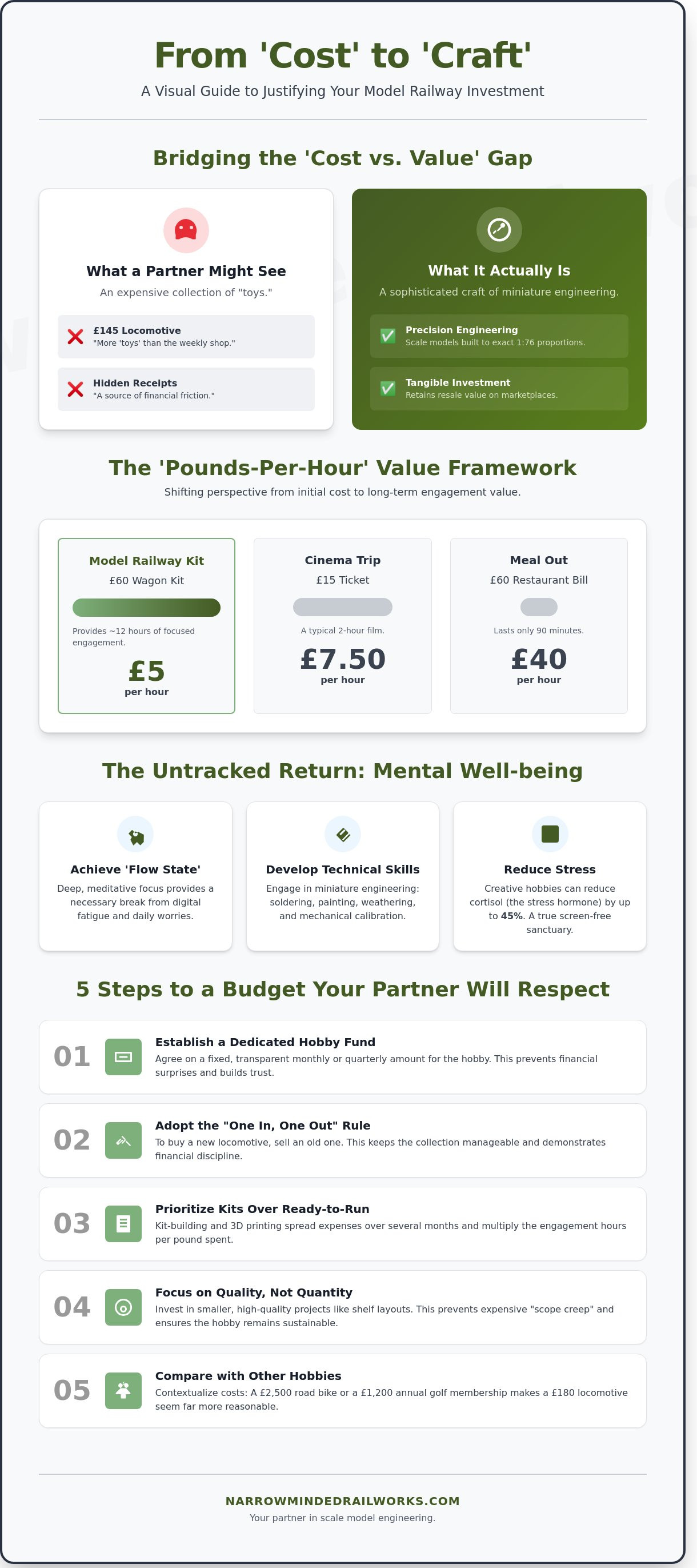
Understanding how to justify model railway costs to partner often requires shifting the perspective from the initial price tag to the duration of the engagement. A £50 wagon kit might look expensive at first glance. However, when you factor in the 15 to 20 hours spent cleaning flash, assembling components, and painting, the cost drops to roughly £2.50 per hour. Compare this to a cinema trip in 2024, where a £15 ticket for a two-hour film equates to £7.50 per hour, or a £60 meal out that lasts only 90 minutes. When you break it down, modelling is one of the most economical ways to fill your leisure time.
Adopting a "Slow Modelling" philosophy is the most budget-friendly way to enjoy the hobby. Instead of rushing to fill a layout with ready-to-run stock, focusing on a single, intricate kit provides weeks of entertainment for the price of a single night at the pub. This focused activity offers more than just a physical product. There are documented mental health benefits of hobbies, including reduced cortisol levels and improved cognitive function. You aren't just buying plastic and brass; you're investing in a structured way to decompress after work.
Creating Your Own Value Calculator
To accurately track your spending, start by estimating the "total engagement time" for every purchase. A standard OO9 scale locomotive kit typically requires 12 hours of assembly and 5 hours of painting and weathering. If you spend another 4 hours researching 1920s Welsh slate prototypes to ensure the livery is correct, that £80 investment has provided 21 hours of engagement. This makes it significantly better value than a £180 ready-to-run model that you simply unbox and place on the track. When you show your partner the "cost per hour" rather than the total spend, the financial logic becomes much clearer.
Comparative Hobby Costs at a Glance
- Cinema Trip: £15.00 for 2 hours = £7.50 per hour.
- Premier League Match: £50.00 for 2 hours = £25.00 per hour.
- Annual Gym Membership: £450.00 (avg. 2 visits/week) = £4.32 per hour.
- Model Railway Kit: £55.00 for 20 hours = £2.75 per hour.
The "Legacy Value" of this hobby is another vital point. Unlike a digital video game or a gym membership, a well-built narrow gauge model is a physical asset. Unique, hand-painted models often retain 75% to 85% of their value on the secondary market. If you ever decide to sell, your hobby has acted as a soft savings account rather than a sunk cost. If you're ready to start a high-value project, you can browse these specialist narrow gauge kits to find your next long-term build.
Kits vs. Ready-to-Run: The Secret to a Sustainable Budget
One of the biggest hurdles when figuring out how to justify model railway costs to partner is the upfront price tag of modern Ready-to-Run (RTR) locomotives. In 2024, a high-specification OO gauge steam engine from major UK manufacturers often retails between £220 and £290. While these models are masterpieces of engineering, they represent a significant hit to the monthly household budget. Kit-building offers a more sustainable path by shifting the focus from "buying" to "creating."
Understanding the psychological drivers of collecting helps explain why we feel the need to acquire these miniature items, but kit-building adds a layer of tangible value through skill acquisition. You aren't just purchasing a product; you're investing in a project that develops precision soldering, airbrushing, and weathering techniques. These skills have a lifelong value that goes beyond the shelf price of the model. Narrow gauge modelling, such as OO9 or GN15, is particularly effective here. Because these scales often rely on "scratch-building" or kit-bashing, the cost of entry is frequently 40% lower than standard gauge alternatives.
The Rise of 3D Printed Kits in Narrow Gauge
Narrow gauge modelling has been transformed by 3D printing technology. Brands like Narrow Minded Railworks provide high-detail locomotive bodies for as little as £25 to £40. These kits are designed to fit onto existing, mass-produced "N gauge" chassis from manufacturers like Kato or Graham Farish, which you can often source for under £35. This flexibility allows you to create a high-quality, unique locomotive for a total investment of roughly £70. It's a fraction of the cost of a £200 standard gauge equivalent, making the hobby far more accessible for those on a strict budget.
Spreading the Cost of a Project
The kit-building route is a brilliant strategy for how to justify model railway costs to partner because it aligns perfectly with monthly pay cycles. You can buy a resin body kit in month one for £30. In month two, you purchase the chassis for £45. By month three, you spend £15 on specific paints and decals. This staggered approach avoids the "big spend" red flags in a joint bank account. It provides three months of hobby engagement for less than £100 total. You end up with a unique piece of rolling stock that reflects your personal craftsmanship rather than just your credit limit.
5 Steps to Organise a Model Railway Budget Your Partner Will Respect
Financial friction is the most common hurdle when learning how to justify model railway costs to partner. To avoid tension, establish a dedicated 'Hobby Fund' that sits entirely outside your essential household bills. By allocating a fixed monthly amount, perhaps £40 to £75, you create a boundary that protects your mortgage and grocery money. This structure proves you've prioritised the family's needs before your own interests.
Adopt the 'One In, One Out' rule to keep your collection manageable. If you want that new £250 Bachmann locomotive, sell off older wagons or a locomotive you no longer run. This keeps your physical footprint stable and often covers 65% of the cost of new rolling stock. Transparency is vital here. A 2023 survey of UK hobbyists suggested that 14% of enthusiasts hide new purchases in the loft or garage; this secrecy is a recipe for disaster. Being honest about costs builds trust that no hidden debt is mounting up.
- Set annual goals to prevent impulse buys at exhibitions like the Great Electric Train Show.
- Use a 'no-questions-asked' monthly spending limit of £30 for both you and your partner.
- Sell old stock on platforms like eBay or at club swap meets to fund layout upgrades.
Financial Transparency and Shared Goals
Present a yearly 'Railway Budget' every January alongside your other household goals. If you plan to spend £500 over twelve months, explain where that money comes from. Use 'found money' such as overtime pay or side hustles to fund the hobby. This ensures the household budget remains untouched. When you hit a financial milestone together, like saving for a summer holiday, your hobby spending feels like a reward rather than a drain on resources.
Making the Hobby a Shared Experience
You'll find it easier to explain the value of your layout when your partner feels a sense of ownership. Ask for their opinion on scenic textures or station colour schemes. Instead of dragging them to a drafty sports hall for a local exhibition, book a trip to a scenic narrow gauge line like the Ffestiniog Railway. This connects the hobby to a pleasant day out. Highlight how the soldering and carpentry skills you've honed on the baseboard have saved you over £200 in professional handyman fees for home repairs this year.
Ready to start building a layout that looks as good as it functions? Check out our range of high-quality narrow gauge kits to begin your next project.
Long-Term Sustainability: Investing in Quality over Quantity
Many modellers fall into the trap of the "dream layout," a massive project that occupies the entire loft and drains the bank account for years. These sprawling empires often remain unfinished skeletons because the cost of 20 metres of track and dozens of locomotives is simply too high. Choosing a smaller, detail-rich project is a smarter financial move that yields a finished result much faster.
Focusing Your Collection
Scale creep happens when your interests wander across different eras and regions, leading to a chaotic pile of expensive stock that doesn't work together. By sticking to a specific narrow gauge theme like OO9 or GN15, you create a focused collection that looks like a curated display rather than a box of clutter. A shelf layout is a space-saving and cost-saving miracle that provides a finished result in months rather than decades. This deliberate focus helps you stay within a set monthly budget, which is a vital part of how to justify model railway costs to partner. You aren't just buying "more stuff"; you're completing a specific, limited project.
- OO9 Scale: Perfect for recreating narrow gauge charm in a tiny footprint.
- GN15 Scale: Large-scale detail that runs on standard OO track, saving you money on infrastructure.
- Defined Scope: A 4-foot plank requires 80% less scenery material than a traditional 8x4 board.
Supporting the British Cottage Industry
Avoiding the big-box retailers in favour of the British cottage industry offers better value and a personal touch. Small-scale designers understand the UK market and provide support that multinational corporations can't match. For example, a bespoke brass locomotive kit might set you back £300, whereas high-quality 3D printed kits from Narrow Minded Railworks offer unique prototypes for as little as £35 to £55. These kits allow you to build a diverse fleet without the eye-watering price tags of traditional manufacturing.
By investing in these kits, you support local innovation while keeping your hobby costs predictable. It's a sustainable way to enjoy the hobby while keeping your household finances healthy. When you can show that your new locomotive cost less than a meal out, how to justify model railway costs to partner becomes a much shorter conversation.
Explore our range of affordable OO9 and GN15 kits and start building a high-quality, sustainable collection today.
Transform Your Hobby Into a Shared Investment
Building a world in miniature doesn't have to be a source of domestic tension. By shifting your focus to the £2 per hour entertainment value rather than the upfront ticket price, you change the conversation entirely. You've learned that switching from ready-to-run models to high-quality kits can slash your monthly layout spend by up to 45% while doubling your actual modelling time. This strategic approach is exactly how to justify model railway costs to partner discussions without feeling guilty about your next purchase.
Focusing on quality over quantity ensures your workshop stays organised and your bank balance remains healthy. If you're ready to prove that this hobby is about craft rather than just consumption, it's time to start your next build. Narrow Minded Railworks provides specialist 3D printed designs in OO9 and GN15 scales that aren't available anywhere else on the market. These unique kits offer a rewarding challenge for UK enthusiasts and ship worldwide directly from our UK workshop.
Start your next project with an affordable Narrow Minded Railworks kit and show your partner just how much value a single box can provide. Your layout deserves the best craftsmanship.
Frequently Asked Questions
Is model railway an expensive hobby compared to others?
Model railways sit in the mid-range of UK leisure spending, often costing less than golf or following a Premier League football team. A typical modeller spends between £500 and £1,500 annually on their layout. When you break this down to a monthly cost of £40 to £125, it compares favourably to a £60 monthly gym membership or a £1,200 annual golf club subscription. It's a long-term investment in a tangible asset.
How can I justify the cost of a 3D printed kit to my partner?
You can justify a 3D printed kit by highlighting the cost per hour of entertainment it provides. A £40 resin body kit might take 15 hours to clean, prime, and paint. This results in a cost of £2.66 per hour, which is significantly cheaper than a £12 cinema ticket. Explaining this hourly value is a great way to learn how to justify model railway costs to partner while showing you're making sensible financial choices.
What is the best way to start a model railway on a tight budget?
Starting with second-hand equipment from platforms like eBay or local exhibition bring-and-buy stalls is the most effective budget strategy. Pre-owned locomotives often sell for 40% less than the RRP of new models. You can find reliable Hornby or Bachmann starter sets for under £80 if you shop for used items. Focus on a small shelf layout to keep track and scenery costs below £100 during your first year.
Should I hide my model railway purchases from my partner?
You shouldn't hide purchases because financial secrecy often leads to friction in relationships. A 2023 survey by a major UK bank found that 15% of couples argue about secret spending on hobbies. Instead of hiding a £150 locomotive, discuss a dedicated hobby budget of £50 per month. This transparency builds trust and allows your partner to understand the joy the hobby brings you without worrying about the household finances or hidden debts.
How much does an average OO9 locomotive kit cost to finish?
A standard OO9 locomotive kit usually costs between £120 and £180 to complete. This total includes a £40 resin or white metal body, a £70 Kato or Tsugawa chassis, and roughly £20 in paint and couplings. If you add a DCC decoder, expect to pay an extra £35. While the initial kit seems cheap, these component costs are necessary to create a fully functional, high-quality narrow gauge engine for your layout.
Can model railways be a good financial investment?
Model railways are rarely a high-return financial investment, as most standard stock depreciates by 30% once used. However, limited edition runs of 500 units or fewer often retain their value or appreciate by 5% to 10% over five years. Treat the hobby as an investment in your mental well-being rather than a savings account. Any resale value should be seen as a bonus rather than a guaranteed profit for your future.
How do I explain that I need 'another' train?
Explain the specific operational role the new locomotive fills on your layout to provide variety. If you're modelling the Southern Region in 1962, you might need a specific Class 33 to pull a set of green coaches. Use this historical context when considering how to justify model railway costs to partner. Point out that each locomotive represents a different piece of engineering history, much like a book collector needs different titles to complete a series.
What are the cheapest scales for narrow gauge modelling?
OO9 is currently the most cost-effective narrow gauge scale due to the wide availability of ready-to-run models and cheap N gauge chassis. You can buy a basic N gauge power bogie for £25 to power a scratch-built body. O16.5 is also affordable because it uses standard 16.5mm OO gauge track, which costs about £4 for a yard of flexi-track. These scales allow you to build detailed scenes without the premium prices of larger gauges.