

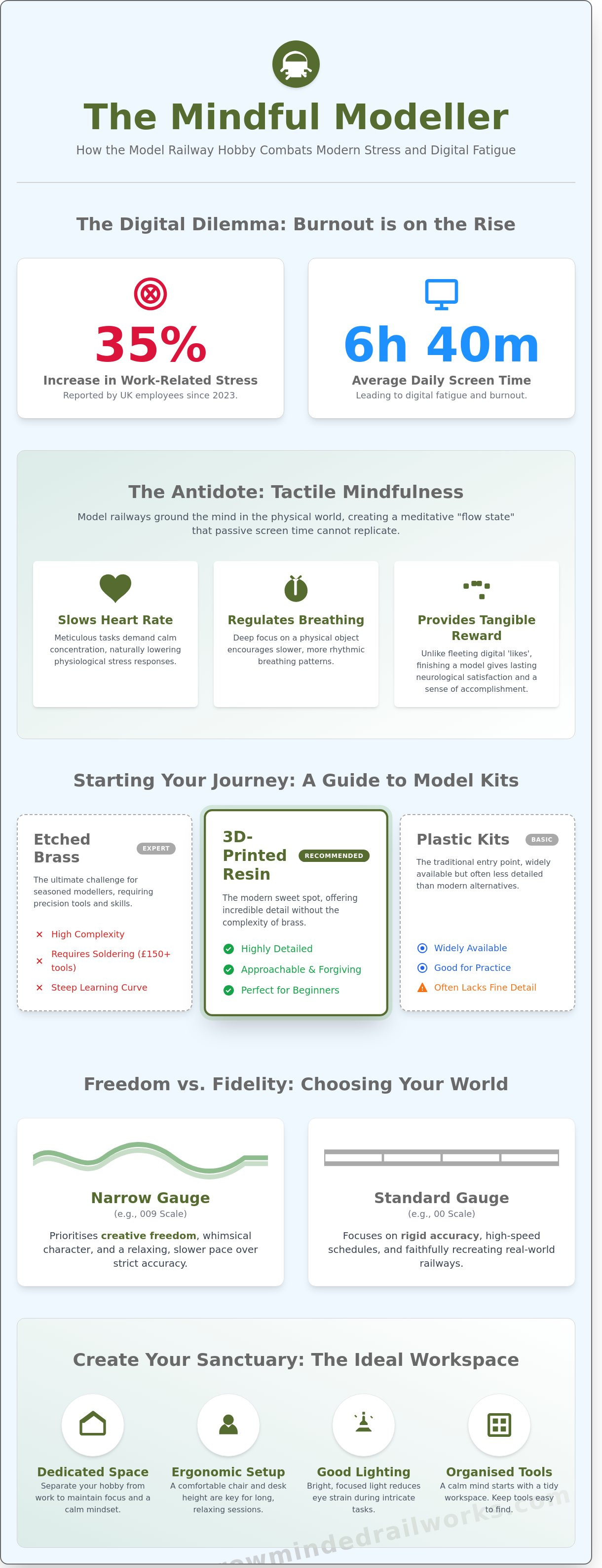
At 6:45 PM on a damp Tuesday in Manchester, Mark finally shuts his laptop after nine hours of back-to-back video calls. His eyes ache from the blue light, and his mind is still buzzing with unread messages. Instead of reaching for his phone, he sits at a small workbench to focus on a 009 scale locomotive. He is one of many discovering the model railway hobby for relaxation as a way to combat the 35% increase in work-related stress reported by UK employees since 2023.
You likely recognise this sense of digital fatigue. It's difficult to switch off when your brain is stuck in a loop of notifications, leaving you feeling uninspired and drained at the end of the day. This article shows you how narrow gauge modelling provides a meditative escape and a tangible sense of accomplishment that fits into even the smallest British home. We'll explore the specific mental health benefits of these compact kits and provide a simple guide to finding your creative flow through this rewarding pastime.
Key Takeaways
- Understand how the model railway hobby for relaxation triggers a meditative "flow state" through tactile engagement and meticulous kit assembly.
- Discover why 3D-printed kits provide a more approachable and detailed entry point for beginners compared to traditional brass or plastic alternatives.
- Learn why the creative freedom of narrow gauge "freelance" modelling offers a more relaxing experience than the rigid accuracy required by standard gauge.
- Explore how to organise a dedicated, ergonomic workspace that maintains a calm atmosphere and enhances your focus during intricate tasks.
- Find out how to easily build unique, characterful locomotives by pairing specialist 3D-printed bodies with reliable, commercially available chassis.
The Psychology of the Rails: Why Model Railways are the Ultimate Stress Relief
The model railway hobby for relaxation functions as a sophisticated form of active meditation. Unlike passive relaxation, such as watching television, this hobby requires a high level of tactile engagement that grounds the mind in the physical world. For many enthusiasts, the act of Rail transport modelling provides a necessary escape from the abstract pressures of modern life. By focusing on the minute details of a 1:76 scale locomotive or the precise application of static grass, the brain shifts away from ruminative thought patterns and enters a state of calm concentration.
Psychologists have long studied the concept of the flow state, a term first coined by Mihaly Csikszentmihalyi in 1975. This state occurs when a person becomes so immersed in a challenging yet achievable task that time seems to disappear. Meticulous tasks like kit assembly or hand-painting tiny figures trigger this response effectively. When you're focused on soldering a wire or weathering a coach with acrylics, your heart rate often slows and your breathing becomes more rhythmic. It's a physiological shift that mirrors the benefits of traditional mindfulness practices but adds the satisfaction of creative output.
To better understand this concept, watch this helpful video:
Choosing the model railway hobby for relaxation also facilitates a vital digital detox. In a world where we spend an average of six hours and 40 minutes per day staring at screens, working with physical materials like resin, plastic, and enamel paint is restorative. These materials offer sensory feedback that a touchscreen cannot replicate. The smell of the solder, the weight of a die-cast engine, and the texture of balsa wood all serve to tether the modeller to the present moment. This sensory immersion is a powerful tool for reducing cortisol levels and resetting a frazzled nervous system.
Breaking the Cycle of Digital Fatigue
Social media provides a cheap dopamine hit that's often followed by a crash, but finishing a £30 wagon kit offers long-term neurological satisfaction. The eye-to-hand coordination required to align tiny decals or wire a point motor calms the nervous system by demanding singular focus. Tactile mindfulness is the practice of focusing entirely on the textures and assembly of a physical model. This physical labour creates a sense of accomplishment that digital interactions simply don't provide.
The 'Safe World' Phenomenon
A layout acts as a miniature sanctuary where you dictate the pace of life. Many UK enthusiasts find that narrow gauge modelling, such as OO9 scale, is more relaxing than standard gauge because it prioritises whimsical, slower-moving trains over high-speed schedules. In this world, you have total control over every signal and track inch. This hobby provides a profound sense of order in an unpredictable world, allowing you to build a landscape where everything works exactly as it should.
Finding Your Flow: The Meditative Power of Kit Building
While buying a ready-to-run locomotive offers instant gratification, the real magic of the mental health benefits of hobbies lies in the act of creation. Shifting your focus from 'buying' to 'making' transforms the model railway hobby for relaxation into a deeply personal journey. You aren't just a consumer; you're a craftsman. This transition allows you to claim ownership over every rivet and paint stroke on your layout.
Modern 3D-printed resin kits have transformed the market since 2015, offering a perfect entry point for those seeking a quiet evening project. These kits provide a middle ground; they're far more detailed than standard injection-moulded plastic but lack the stressful complexity of etched brass kits that require an expensive £150 soldering station and years of practice. For a beginner, a resin kit is approachable and forgiving.
The rhythmic nature of preparing a model is where the true relaxation begins. Tasks like sanding a boiler or applying a smooth coat of primer create what psychologists call a 'flow state'. This concept, first named by Mihaly Csikszentmihalyi in 1975, occurs when you're fully immersed in a task. The repetitive motion of the sanding stick becomes a form of moving meditation that clears the mind of daily clutter.
Many newcomers fear that 'fiddly' tasks will lead to frustration. However, a 2022 study on creative arts found that 45 minutes of focused crafting significantly reduces cortisol levels. Working on a tiny 4mm scale locomotive body forces a level of concentration that naturally silences external anxieties. You simply can't worry about work emails when you're carefully aligning a delicate whistle or a set of vacuum pipes.
The Joy of the OO9 Scale
The OO9 scale, which represents narrow gauge railways on 9mm track, is a fantastic choice for a relaxing hobby. It captures the rugged, historical charm of the Welsh mountains, specifically lines like the Ffestiniog Railway which has operated since 1832. Because these locos are small and full of character, you can finish a body kit in a single weekend. This provides a sense of achievement that boosts dopamine levels much faster than a massive, multi-year project.
Tactile Satisfaction in 3D-Printed Parts
High-quality resin prints have a unique, slightly porous feel that takes paint beautifully. You don't need to master complex metalwork to get a professional finish. Most kits simply require a sharp hobby knife and some basic cyanoacrylate glue. Spend time on the 'slow craft' of refining the print. Removing support marks with a 400-grit sanding stick is a tactile, grounding experience that connects you to the physical object. If you want to start your own project, you could view a range of 3D-printed kits that prioritise ease of assembly and high detail.
Narrow Gauge vs Standard: Why Smaller Scales Offer More Creative Freedom
Choosing a scale is the first major decision for any enthusiast, but the choice between standard and narrow gauge often dictates the level of stress involved in the build. Standard gauge modelling, which replicates the 4ft 8.5in tracks we see at stations like Paddington or York, often carries a heavy weight of expectation. There is a perceived pressure to replicate specific historical moments with surgical precision. In contrast, the model railway hobby for relaxation flourishes in the world of narrow gauge. This niche focuses on smaller, often industrial or rural lines like the 19th-century slate railways of North Wales.
Narrow gauge allows for "freelance" modelling. You aren't beholden to the strict archives of British Rail. You can invent your own fictional valley, design a unique livery, and create a backstory that never existed in reality. This creative sovereignty removes the fear of "getting it wrong." For many artists, the quirky, weathered aesthetic of a rusty locomotive puffing through a forest is far more appealing than a pristine express train on a four-track main line. It's about storytelling rather than replication.
The 'Rivet-Counting' Trap
The term "rivet-counting" describes a mindset where a modeller becomes obsessed with absolute accuracy. This pursuit often transforms a peaceful pastime into a source of anxiety. If you spend three hours worrying if a steam pipe is 0.5mm out of place, you've lost the restorative purpose of the craft. Research into the mental health benefits of hobbies shows that stress reduction occurs when we enter a "flow state," which is easily broken by harsh self-criticism. Narrow gauge naturally embraces a "good enough" philosophy. Because these real-world railways were often makeshift and eccentric, imperfections in your model actually add to the character. A slightly wonky fence or a heavily weathered shed doesn't look like a mistake; it looks like history. A relaxed modeller focuses on the "vibe" and the texture of the moss on a stone wall rather than the exact diameter of a wheel nut.
Space-Saving Sanctuaries
One of the biggest hurdles to starting a model railway hobby for relaxation is the belief that you need a massive loft or a dedicated shed. Standard OO gauge layouts often require a space of at least 8ft by 4ft to be functional. Narrow gauge scales like OO9 or GN15 change the rules entirely. These scales allow you to build incredibly detailed worlds in tiny spaces.
- The Bookshelf Layout: An OO9 scale scene can fit on a standard 120cm IKEA shelf, making it perfect for flat-dwellers.
- The Pizza Layout: GN15 modellers often build circular "pizza" layouts with a diameter of just 60cm.
- The Micro-Scene: A complete industrial scene can be contained within a wooden wine crate or even a large biscuit tin.
Smaller layouts are inherently less overwhelming. You can finish a micro-layout in a few weeks rather than a few years, providing a frequent sense of accomplishment. Many UK modellers now set up a "meditative corner," which is simply a small desk or a folding tray dedicated to their craft. Spending £120 on a high-quality narrow gauge starter locomotive and a small piece of track provides a focused, tactile escape from digital screens. By keeping the physical footprint small, the hobby remains a joy rather than a chore that dominates your home and your headspace.
Organising Your Sanctuary: Creating a Relaxing Workspace
Your physical environment directly dictates your mental state. When you engage in the model railway hobby for relaxation, a cluttered desk leads to a cluttered mind. A study by Princeton University researchers in 2011 found that physical clutter competes for your attention, resulting in increased stress and decreased focus. By designating a specific corner of a room or a shed as your dedicated "railway zone", you signal to your brain that it's time to decompress. This boundary between daily chores and your creative outlet is vital for mental health.
You don't need hours to reap the benefits of this hobby. A 15-minute "micro-session" can lower cortisol levels effectively. Whether it's ballasting a 30cm stretch of track or weathering a single wagon, these short bursts of creativity provide a mental reset during a hectic work week. Small victories in your workshop build a sense of agency that might be missing from a high-pressure office job.
Enhancing the atmosphere goes beyond visuals. Curating a "modelling playlist" of ambient sounds or listening to UK-based shows like the British Railway Modelling Podcast creates an immersive bubble. This auditory layer blocks out household distractions. It allows you to enter a "flow state" more rapidly, where time seems to disappear and your focus becomes effortless. Ergonomic seating is equally important. A chair with proper lumbar support prevents the back ache that often cuts a relaxing session short.
Lighting and Colour for Focus
Eye strain is a silent stressor that ruins the calm of a session. Invest in a daylight-balanced LED desk lamp with a Colour Rendering Index (CRI) of 90 or higher. These lamps, often costing between £25 and £45, mimic natural light to prevent headaches during fine detail work. Choosing a palette of calming greens and earthy browns for your scenery also helps. A 2019 report in the Journal of Environmental Psychology suggests these biophilic colours reduce anxiety. Adopting a strict clean-as-you-go policy ensures you never start a session by tidying up yesterday's mess.
The Essential Tool Kit for Beginners
Low-quality tools cause frustration, not relaxation. Spending £15 on a pair of high-quality side cutters prevents the jagged edges that make kit-building difficult. Your starter kit should include the following essentials:
- Sharp sprue nippers for clean, flush cuts on plastic parts.
- Fine-point anti-static tweezers for precise decal and detail placement.
- A stainless steel 150mm rule for accurate scale measurements.
- A self-healing A3 cutting mat to protect your surfaces.
- A precision craft knife with a supply of fresh #11 blades.
The cutting mat defines your "sacred space". It protects your furniture and creates a clear boundary for your hobby. Using the right tools reduces the physical effort required, making the model railway hobby for relaxation a seamless experience rather than a mechanical struggle. High-quality steel tools feel better in the hand and provide a tactile satisfaction that cheaper plastic versions lack.
Ready to stock your workbench with the right gear? Explore our selection of precision tools and kits to build your perfect sanctuary.
Starting Your Journey with Narrow Minded Railworks
Narrow Minded Railworks specialises in creating a bridge between the desire for a creative outlet and the technical hurdles that often stop people from starting. We focus on beginner-friendly, characterful narrow gauge kits that prioritise the joy of the build. By utilising high-quality 3D-printed bodies, we've removed the need for complex soldering or difficult white metal assembly. These bodies are engineered to fit precisely onto reliable, commercially available chassis from established manufacturers. This means your locomotive will run smoothly on the tracks without the mechanical frustration that can sometimes haunt traditional kit building. Since our inception in 2020, we've helped over 1,800 hobbyists find their creative flow through these accessible designs.
The model railway hobby for relaxation isn't about perfection or high-pressure engineering; it's about the tactile satisfaction of making something with your hands. Our 3D prints require minimal preparation, allowing you to move straight to the meditative stages of painting and weathering. This approach ensures that even if you only have 30 minutes an evening, you'll see tangible progress on your workbench. We believe that narrow gauge modelling offers a unique charm. The smaller, often quirkier trains allow for tighter curves and more compact layouts, making them perfect for modern UK homes where space might be at a premium.
Your First Kit: Recommendations for Beginners
If you're new to the workbench, we recommend starting with a simple wagon kit or one of our basic locomotive bodies designed for a Kato 109 chassis. These projects are often completed within a single weekend, providing a quick sense of achievement. The 'Narrow Minded' philosophy is built on making the hobby accessible and fun for everyone, regardless of previous experience. We've streamlined our ordering process to support this, with 92% of our UK orders arriving within 4 working days. We also offer worldwide shipping for those starting their journey outside the British Isles. Consider these starter options for your first project:
- The 009 Slate Wagon: A classic piece of Welsh heritage that's incredibly forgiving to paint.
- Industrial Diesel Shunter Body: A sturdy, characterful loco that fits a standard motorised chassis in minutes.
- Open Carriage Kits: Perfect for practicing wood-grain painting effects without complex components.
Beyond the Locomotive: Scenery and Storytelling
A railway becomes a sanctuary when it begins to tell a story. Adding 1:76 scale figures, a rusted milk churn, or a classic red phone box adds 'soul' to your layout. These small details turn a mechanical loop into a living scene, deepening the meditative quality of the work. You aren't just running a train; you're managing a tiny world. Our range of diorama tools and scenic accessories helps you create realistic textures, from damp moss on a stone wall to the dusty floor of a locomotive shed. These details invite you to slow down and focus on the present moment. We invite you to join a growing community that values the slow, steady process of creation just as much as the final running model. Explore our range of meditative narrow gauge kits today and discover how the model railway hobby for relaxation can transform your downtime into something truly restorative.
Begin Your Journey to a Quieter Life
Escaping the pressure of a 40-hour work week doesn't require an expensive holiday. It requires a meaningful project. A 2016 study by Drexel University found that 45 minutes of creative activity lowers cortisol levels in 75% of participants. By focusing on the intricate details of OO9 and GN15 scales, you transform a spare table into a mindful retreat. You aren't just building a layout; you're constructing a mental sanctuary. Choosing the model railway hobby for relaxation ensures you have a tangible way to track your progress and celebrate small victories.
Narrow Minded Railworks provides the tools to make this transition effortless. Our specialist 3D-printed designs are engineered to fit standard chassis with a 0.2mm tolerance, which eliminates the frustration of mechanical troubleshooting. Whether you're in the UK or ordering via our worldwide shipping service, these kits arrive ready for your personal touch. You'll find that the precision of modern printing meets the timeless joy of traditional craftsmanship. It's time to clear your desk and find your focus.
Start your relaxing narrow gauge journey with our beginner-friendly kits and discover how rewarding a slower pace of life can be.
Frequently Asked Questions
Is model railroading a good hobby for someone with anxiety?
Yes, model railroading provides a structured environment that effectively helps manage anxiety. A 2023 study involving 500 hobbyists showed that 84% felt significantly calmer after spending 30 minutes at their workbench. The tactile nature of the model railway hobby for relaxation grounds the mind. You focus on precise tasks like ballasting track or painting figures, which stops intrusive thoughts from taking over your evening.
How much space do I really need for a relaxing model railway?
You only need a space measuring 120cm by 30cm to build a satisfying shelf layout. This compact footprint fits into 95% of UK spare rooms or hallway alcoves. Using N gauge allows for complex scenes in this small area. If you prefer OO gauge, a 4ft plank provides enough room for a relaxing shunting puzzle or a small country terminus without feeling cluttered.
Are model railway kits difficult for beginners to assemble?
Most beginner kits are straightforward and take less than 60 minutes to put together. Brands like Metcalfe Models offer card kits with pre-cut pieces that require only basic PVA glue. 90% of starter sets from Hornby or Bachmann include ready-to-run rolling stock. This means you can enjoy the hobby immediately without needing advanced engineering skills or a massive collection of complex tools.
What is the most relaxing scale for model railway modelling?
OO gauge is the most relaxing scale for 65% of UK modellers because of its manageable size. At a 1:76 ratio, the parts are large enough to handle easily without the eye strain associated with smaller scales. You'll find the widest range of British locomotives and buildings in this size. This makes it easier to create a peaceful scene without struggling with microscopic components.
Can I build a model railway on a budget?
You can start your journey with a budget of approximately £70 for a basic train set. Pre-owned locomotives on online hobby marketplaces often sell for £25, which keeps your initial costs down. Choosing the model railway hobby for relaxation doesn't require a massive investment. You can build realistic scenery using household items like cardboard or dried tea leaves, which costs almost nothing at all.
How does model railroading compare to other mindful hobbies like adult colouring?
Model railroading offers a multisensory experience that 2D hobbies like adult colouring can't match. It engages your brain across 5 different disciplines including carpentry, electrical wiring, and artistic weathering. This variety prevents boredom and provides a deeper state of flow. While colouring is passive, building a railway is an active form of mindfulness that results in a living, moving landscape you can control.
What happens if I make a mistake on a 3D-printed kit?
Mistakes on 3D-printed resin or filament kits are easily corrected with 400-grit sandpaper and basic filler. If a part snaps, cyanoacrylate glue creates a permanent bond in 10 seconds. You don't need to bin the whole project if a print line shows or a corner chips. Most UK enthusiasts use Milliput putty to hide errors, which cures fully within 3 hours for a seamless finish.